
For years, bonds were about as exciting as watching paint dry.
Interest rates were near zero, yields were miserable, and investors could reasonably ask this question.
Why would I lock up my money for years to earn almost nothing?
Then inflation showed up. The Federal Reserve aggressively raised interest rates. Bond prices got crushed.
Suddenly, the investment that was supposed to be boring became painfully exciting.
But here's the question investors should be asking today:
Are bonds finally making a comeback?
I think the answer could be yes.
Bonds Actually Pay You Again
For much of the decade following the financial crisis, conservative investors had a problem.
There simply wasn't much income available without taking additional risk.
That's changed dramatically.
The 10-year Treasury yield has recently approached 5%, while some longer-term Treasury yields have moved above 5%.1
That means investors can potentially earn meaningful income from high-quality fixed-income investments without having to own another technology stock, chase a speculative investment, or wonder what cryptocurrency is going to do tomorrow.
Five percent isn't sexy. But 5% isn't nothing either. It's often referred to as the risk-free rate of return.
Put $1 million into investments yielding 5%, and you're talking about roughly $50,000 of annual income before taxes, assuming the yield and principal remain as expected.
For retirees, that matters.
Real Return vs. Nominal Return
Here's an important nuance most investors miss.
When we talk about a 5% Treasury yield, that's a nominal return. Your real return is what's left after inflation.
If a bond pays 5% and inflation runs at 3% over the life of that bond, your real return is closer to 2%.
Here's why this matters for a fixed-income investor:
If you buy a high-quality bond and hold it to maturity, you generally receive your principal back at the end of the term, assuming the issuer doesn't default. In other words, you're not exposed to price fluctuations in the same way a bond fund investor is.
But by locking in a 5% yield today, you're essentially making a bet that inflation will not exceed 5% over the life of that bond. If it does, your real purchasing power declines even though your nominal return is exactly what you signed up for.
That's why understanding the difference between what your money earns and what your money is actually worth matters more than most people realize.
Why Did Bonds Get Crushed?
Here's the part investors need to understand.
Bond prices and interest rates generally move in opposite directions.
Suppose you bought a bond paying 2%, and newly issued comparable bonds suddenly pay 5%.
Who wants your 2% bond?
To make it competitive, its market price generally has to fall.
That's essentially what happened as rates rose rapidly. Investors who thought their bond funds were "safe" discovered they could lose real money.
The Bloomberg U.S. Aggregate Bond Index, one of the broadest measures of the bond market, lost more than 13% in 2022, its worst calendar year in decades.2
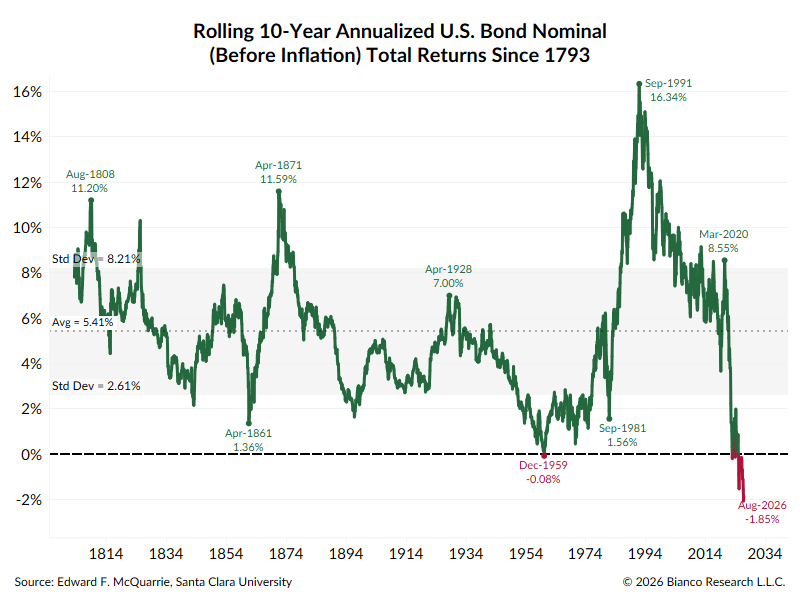
To put that in real context, the last decade has produced some of the worst rolling 10-year returns for U.S. bonds in over 230 years.3 That's not a typo. Since 1793, we've rarely seen a period this challenging for fixed income. Which, ironically, is often exactly the kind of setup that precedes better forward returns.
That wasn't normal.
But it taught investors an important lesson:
Bonds aren't the same thing as cash.
Know What You're Buying
There is also a major difference between owning an individual bond and owning a bond fund.
Buy an individual high-quality bond for $1,000 and hold it until maturity, and assuming the issuer doesn't default, you generally know the amount you're scheduled to receive at maturity.
A bond fund doesn't mature.
Its value continually changes as interest rates, credit conditions, and the bonds inside the portfolio change.
That's why investors need to look beyond the word "bond." Because interest rates and bond fund prices have a see-saw relationship.
Understand the yield. Understand the maturity. Understand the credit quality. And especially understand duration, which helps measure how sensitive your bond investment may be to changes in interest rates.
Don't Chase Yield
If Treasuries are paying attractive yields, think twice before reaching for an 8% or 10% bond simply because the number looks better.
Higher yield usually means higher risk.
Remember one of the oldest rules in investing:
There's no free lunch.
So, Are Bonds Back?
For the first time in years, bonds could deserve a seat at the portfolio table.
Not because they're going to outperform Nvidia.
Not because they're suddenly exciting.
But because bonds can once again potentially provide three things investors actually need:
Income. Diversification. Predictability.
Here's what's interesting. Even with yields this attractive, investor sentiment toward bonds is currently near multi-year lows, with recent readings showing only around 9% of surveyed investors bullish on the space [4]. In other words, almost nobody wants to own them right now.
That's usually when things get interesting.
For years, Wall Street used the acronym TINA, "There Is No Alternative," to explain why investors kept piling money into stocks when interest rates were near zero.
At today's yields, there finally may be an alternative.
Bonds probably aren't going to make you rich.
But when high-quality bonds can pay around 5%, boring doesn't look so bad anymore.
CFP®, CRPC®, CRPS®, AWMA®, AAMS®, CMFC®, CEPA®
CEO & Managing Partner · Exit Wealth®
SOURCES
- U.S. Treasury Daily Yield Curve — home.treasury.gov/resource-center/data-chart-center/interest-rates
- Bloomberg U.S. Aggregate Bond Index 2022 Performance — bloomberg.com
- Rolling 10-Year U.S. Bond Returns Since 1793 — Edward F. McQuarrie, Santa Clara University, via Bianco Research L.L.C.
All opinions expressed in this newsletter are for general informational purposes and constitute the judgment of the author(s) as of the date of the newsletter. The opinions and views expressed by the author are personal and based on economic or market conditions at the time of publication. Actual economic or market events may turn out differently than anticipated. Nothing in this material is intended to serve as personalized investment, tax, or insurance advice. These opinions are subject to change without notice and are not intended to provide specific advice or recommendations for any individual.
The material has been gathered from sources believed to be reliable, however Exit Wealth® cannot guarantee the accuracy or completeness of such information, and certain information presented here may have been condensed or summarized from its original source. To determine which investments may be appropriate for you, consult your financial advisor prior to investing. As always, please remember investing involves risk and possible loss of principal capital and past performance does not guarantee future returns; please seek advice from a licensed professional.